
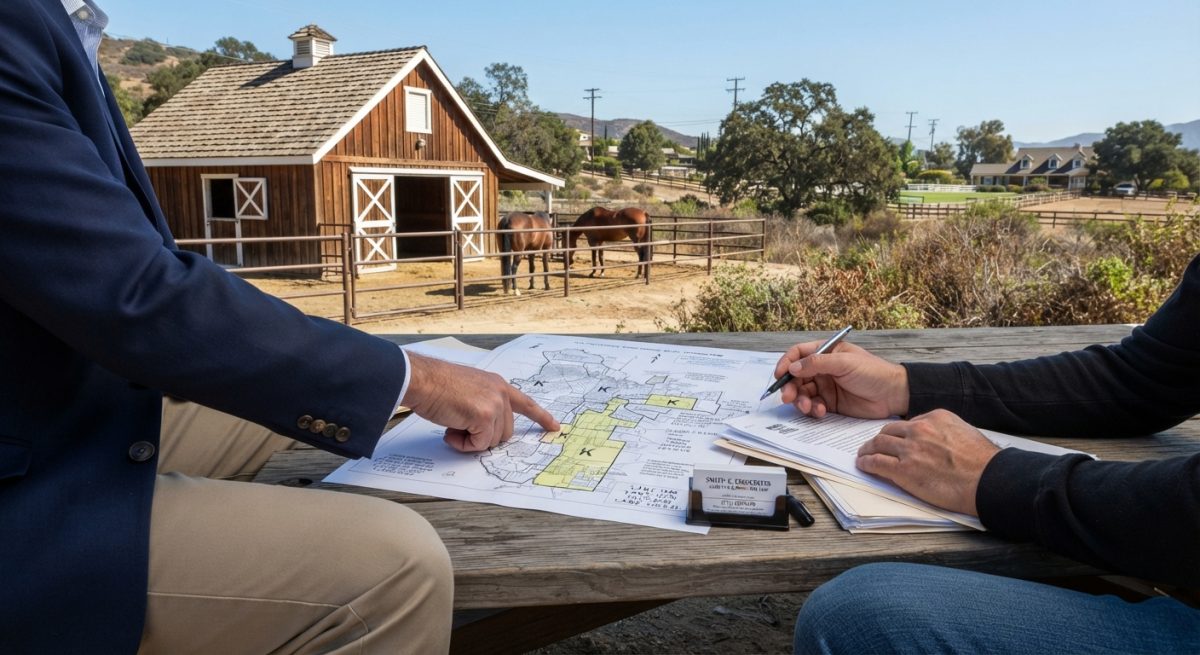
For property owners in Los Angeles's equestrian and semi-rural communities, keeping horses can be an important part of daily life. It can also create zoning, building, licensing, sanitation, and property-use issues that may come to the attention of City agencies.
A complaint, inspection, Order to Comply, or administrative citation does not necessarily mean that an owner must remove horses or demolish a stable. The appropriate response depends on the property's zoning, K Equinekeeping District status, lot history, permits, location of animal enclosures, number of animals, and the specific Los Angeles Municipal Code provision involved.
Los Angeles Horse and Animal-Keeping Zoning Rules
The City of Los Angeles has specific zoning regulations governing the keeping of horses and other animals. In some areas, additional regulations apply through K Equinekeeping Districts.
The City's K Equinekeeping District regulations establish requirements concerning equine enclosures, setbacks, animal density, licensing, and certain nonconforming equine uses.
However, simply living in an area known for horses does not automatically establish a right to keep any number of animals or maintain any type of stable. Property owners should determine the actual zoning classification and other land-use restrictions applicable to their parcel.
Important factors can include:
- The property's underlying zoning classification.
- Whether the property is located within a K Equinekeeping District.
- The size and legal history of the lot.
- The location of stables, corrals, barns, pens, and other animal enclosures.
- Whether structures were legally permitted.
- The number and type of animals being kept.
- Applicable specific plans or other land-use regulations.
- Whether an existing animal-keeping use qualifies as a lawful nonconforming use.
Los Angeles City Planning's ZIMAS property search is a useful starting point for determining a property's zoning and reviewing available planning and building-permit history.
Equine Enclosure Setbacks in Los Angeles
One of the most important issues in Los Angeles horse-property disputes is the location of an equine enclosure.
Under the K Equinekeeping District regulations, when an equine enclosure is less than 75 feet from the habitable rooms of a neighboring dwelling, the enclosure generally cannot be closer to the neighbor's habitable rooms than it is to the habitable rooms of a dwelling on the equinekeeping property.
There is also a 35-foot minimum rule. An equine enclosure cannot be located closer than 35 feet to the habitable rooms of a dwelling unit under the applicable K District provision.
The regulations also contain rules governing where animal-keeping structures may be placed on a lot. For example, an animal-keeping structure in a K District generally cannot occupy the required front yard and is subject to a 10-foot distance from required side lot lines, along with additional restrictions affecting certain yards adjoining property outside the K District.
Because setback requirements can depend on the property's zoning and surrounding properties, owners should avoid relying on a simple measurement or informal advice from a neighbor.
How Many Horses Can You Keep on a Los Angeles Property?
There is no single horse-per-acre rule that applies to every Los Angeles property.
The number of horses that may be kept depends on the zoning regulations applicable to the particular parcel.
For example, certain lots in K Equinekeeping Districts formed after January 12, 1975, are limited to one equine for each 4,000 square feet of lot area.
Other residential zones have different requirements. The rules can also distinguish between keeping animals as part of a residential use and operating a commercial equine business.
For example, the City's A2 Agricultural Zone regulations permit certain residential livestock keeping only on lots of at least 17,500 square feet. Where equines or bovines are kept, the number may not exceed one equine or bovine for each 4,000 square feet of lot area. The A2 zoning rules contain the applicable requirements.
The RE Residential Estate Zone also has its own equine regulations, including a minimum lot size of 17,500 square feet and a limit of one equine for each 4,000 square feet of lot area.
These differences demonstrate why a horse owner should determine the actual zoning classification of the property before assuming that a particular horse-to-acreage calculation applies.
Common Los Angeles Stable and Animal-Keeping Code Violations
Animal-keeping enforcement can involve much more than the number of horses on a property.
Unpermitted Stables and Structures
A stable, barn, tack room, shelter, retaining wall, shed, or other structure may require permits or may not comply with applicable zoning and building requirements.
An owner who purchased a property with an existing structure may still face an enforcement issue if the structure was never legally permitted. The City of Los Angeles Department of Building and Safety states that the current property owner is responsible for complying with an Order to Comply even when a previous owner or tenant performed the unpermitted work.
Setback Violations
A corral, stable, pen, or other equine enclosure may be alleged to violate required setbacks from neighboring residences, habitable rooms, property lines, or required yards.
Excessive Animal Density
A property may be cited if the number of horses or other livestock exceeds the number permitted under the applicable zoning regulations.
Equine Licensing Problems
Los Angeles also has separate licensing requirements for equines. A horse's license is an animal-regulation issue and does not by itself establish that a stable is properly permitted or that the property complies with zoning requirements.
Grading, Drainage, and Retaining Walls
Horse properties can involve grading, drainage improvements, retaining walls, driveways, fences, and other site work. These improvements may create separate permitting or code-enforcement issues.
Manure, Odor, Flies, and Sanitation
Complaints involving manure, odors, flies, runoff, drainage, or general property conditions may also result in investigation by an appropriate City agency.
Property-Line Disputes
A dispute involving a fence, corral, manure area, stable, or other improvement may actually concern the location of the property line rather than a zoning violation. A survey or other property documentation may therefore be important.
What to Do After Receiving a Los Angeles Code Violation Notice
Receiving an Order to Comply or other enforcement notice can be stressful, particularly when the property has housed horses for many years. The most important step is to understand exactly what the City is alleging.
Read the Notice Carefully
Determine which City department issued the notice, the case number, property address, cited code sections, alleged violations, compliance deadline, required corrections, and any appeal procedures.
The City's LADBS code-enforcement information advises property owners receiving an Order to Comply to read the order carefully and identify which items require permits.
Determine What Kind of Enforcement Action You Received
An Order to Comply, administrative citation, animal-licensing notice, permit correction notice, and nuisance complaint may involve different procedures and deadlines.
Do not assume that every type of City notice can be challenged in the same way.
Document the Property
Take dated photographs and video of the stable, corral, fencing, animal enclosures, manure-management area, drainage features, and surrounding property.
Preserve communications with City inspectors, contractors, neighbors, and other people involved in the dispute.
Research the Property's History
Historical records can be particularly important in horse-property cases.
Useful documents may include:
- Building permits
- Site plans
- Surveys
- Certificates of Occupancy
- Zoning records
- Equine licensing records
- Historical photographs
- Aerial photographs
- Prior inspection records
- Title documents
- Evidence showing when a stable or equine use began
A long-established stable may raise different legal questions from a newly constructed structure.
Verify the Zoning
Check the property's actual zoning classification and whether it is located within a K Equinekeeping District. Also look for applicable overlays, specific plans, or other restrictions.
ZIMAS can provide useful property-specific information, but the actual applicable zoning provisions should be reviewed before reaching a legal conclusion.
Correct Clear Safety Problems
If the notice identifies an obvious safety or sanitation problem, appropriate corrective action may be advisable. This could include addressing unsecured animals, unsafe structures, drainage problems, or significant manure accumulation.
However, owners should be careful about making substantial physical changes without first determining whether permits are required.
Do Not Create Another Violation While Fixing the First
Moving or rebuilding a stable, relocating a corral, constructing a retaining wall, changing drainage, or expanding an enclosure may require permits or additional approvals.
Before undertaking substantial construction or site work, determine what approvals are required.
Keep Track of Deadlines
This is particularly important. Missing a compliance deadline, hearing date, payment deadline, or appeal deadline can affect the owner's options.
LADBS provides procedures for certain requests for modification and appeals involving Department determinations. The specific procedure, however, depends on the type of notice and the underlying matter.
Lawful Nonconforming Horse Uses and "Grandfathered" Stables
One of the most important issues in an older Los Angeles horse-property dispute may be whether an existing equine use or structure has lawful nonconforming status.
Property owners sometimes describe these situations as being "grandfathered." That term can be misleading because simply having an old stable does not automatically establish a permanent right to continue using it.
The City code generally recognizes nonconforming buildings and uses under specific circumstances. The key question is often whether the use or structure was lawfully established under the regulations that applied at the time.
The City's nonconforming-use provisions contain specific provisions addressing equine uses, including separate rules for K and non-K Equinekeeping District properties.
Evidence of a property's history may therefore be extremely important.
Non-K Equinekeeping Properties
Los Angeles Municipal Code § 12.23(G) addresses certain nonconforming equine uses on lots outside K Equinekeeping Districts.
Under that provision, a legally established equine use may be allowed to continue when a neighboring property later receives a building permit for a dwelling within the applicable 75-foot distance.
The provision imposes important conditions. Among other things, the equine enclosure cannot be closer than 35 feet to the habitable rooms of a dwelling, and the subject property must have had an Equine License designating it to stable at least one licensed equine during the 12 months preceding the neighboring building permit.
The enclosure also cannot be expanded, extended, or relocated in a way that reduces the applicable nonconforming distance.
A separate provision, § 12.23(I), addresses a narrower historical situation involving an equine use outside a K District that was legally established before November 22, 1982, followed by a neighboring residential building permit issued between November 22, 1982, and July 1, 1986.
These provisions are highly fact-specific. A property owner should not assume that an old stable qualifies simply because it has existed for decades.
K Equinekeeping District Properties
K District properties have separate nonconforming-use provisions under LAMC § 13.05.
For example, § 13.05(C)(7) addresses situations in which an equine use was legally established before a neighboring residential building received a permit within the applicable required distance.
The provision contains conditions involving the 35-foot minimum distance, prior equine licensing, and restrictions on expanding or relocating the enclosure.
There is also a separate historical provision in § 13.05(C)(8) addressing certain K District equine uses legally established before November 22, 1982, and neighboring residential permits issued during a specified historical period.
These provisions should be examined based on the property's actual history rather than treated as a general "grandfathering" rule.
Can a Nonconforming Horse Use Be Lost?
Yes. Nonconforming status is not necessarily permanent.
For the specific equine provisions discussed above, the Los Angeles Municipal Code provides that the nonconforming equine use can be discontinued if, during a successive three-year period, no equine is licensed by the Department of Animal Services to be stabled on the subject lot.
Other restrictions can also apply to the expansion, relocation, or alteration of a nonconforming use or structure.
This is one reason historical documentation and current licensing records can be important in a dispute involving an older Los Angeles stable.
Possible Responses to a Stable or Animal-Keeping Violation
The appropriate response depends on the specific code section and facts of the case. Potential issues to investigate may include:
- Whether the property is actually in the zoning district identified by the City.
- Whether the property is located within a K Equinekeeping District.
- Whether the City's measurements of the lot, enclosure, or setbacks are accurate.
- Whether the number of animals has been calculated correctly.
- Whether a stable or other structure was previously permitted.
- Whether the property has a lawful nonconforming use.
- Whether historical permits, licenses, photographs, or aerial imagery support the owner's position.
- Whether the notice accurately identifies the condition that must be corrected.
- Whether an appeal, permit application, zoning review, or other administrative remedy is available.
A neighbor's property having a similar stable or similar animal-keeping conditions does not automatically establish that the cited property is legal. Nevertheless, evidence concerning comparable properties and the City's treatment of similar situations may sometimes be relevant to evaluating an enforcement matter.
When to Consult a Los Angeles Land-Use Attorney
Some animal-keeping disputes can be resolved through permitting, correction of a relatively minor violation, or clarification with the appropriate City department.
Other cases can involve much more significant property rights.
A Los Angeles attorney may be particularly useful when a case involves:
- A longtime horse or livestock use
- A disputed "grandfathered" or nonconforming stable
- A threatened order to remove animals
- A substantial fine
- An unpermitted stable or other structure
- Grading or retaining-wall issues
- A disputed property-line or setback issue
- A pending administrative hearing
- A disagreement over the interpretation of Los Angeles zoning regulations
The earlier the property owner understands the legal and factual basis of the City's position, the more opportunities there may be to address the problem before it becomes more difficult or expensive to resolve.
Final Thoughts
Los Angeles animal-keeping and stable code violations can involve much more than simply determining whether a property is large enough for a particular number of horses.
Zoning classification, K Equinekeeping District status, enclosure setbacks, permits, licensing, property history, and nonconforming-use rules can all affect the analysis.
Property owners who receive a notice should preserve their records, verify the applicable zoning regulations, understand the exact violation being alleged, and pay close attention to all response deadlines.
For significant disputes involving established horse properties, stables, equine enclosures, or threatened enforcement action, obtaining advice from an attorney familiar with Los Angeles zoning and land-use law can help protect the owner's property interests.
Disclaimer: This article is for general informational purposes only and is not legal advice. It does not create an attorney-client relationship. Laws and deadlines can change, and the application of law depends on the facts of each matter. Consider speaking with a qualified California attorney promptly about a specific potential claim.