
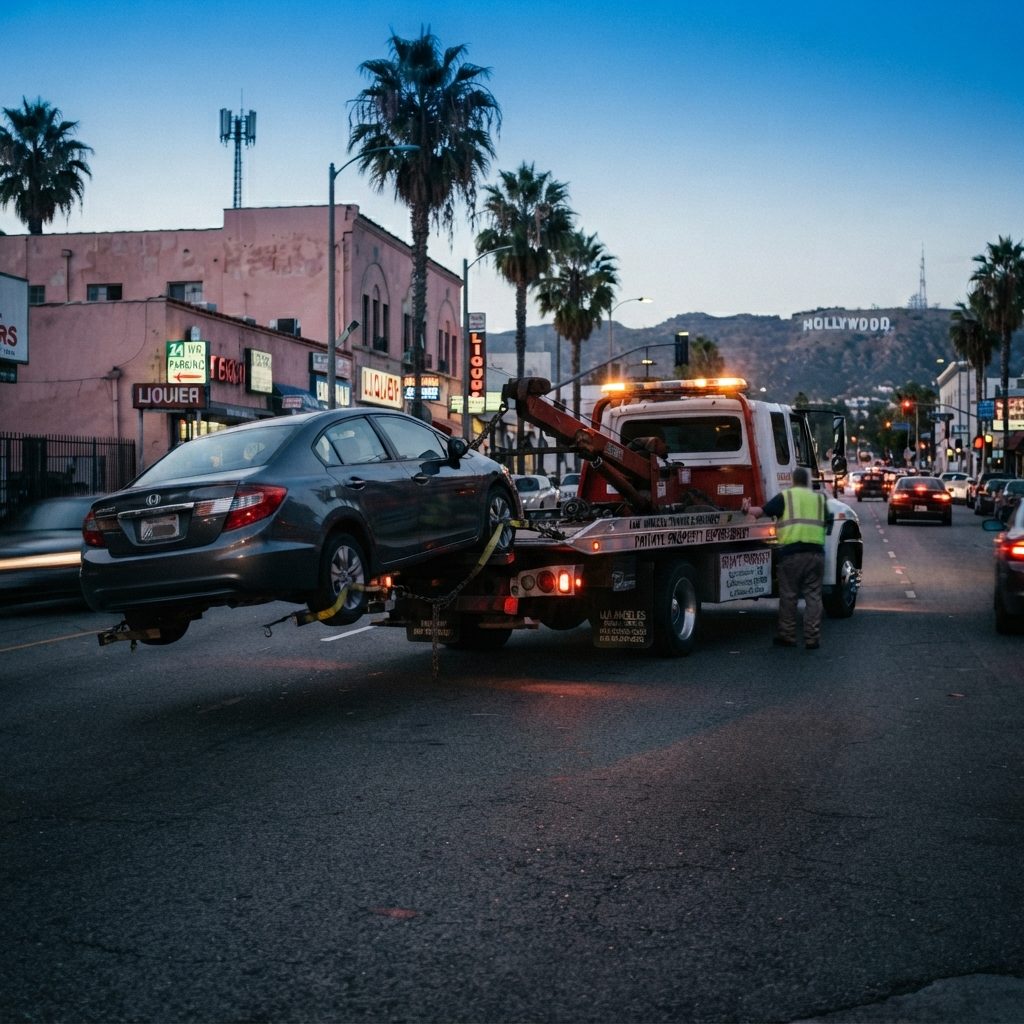
There is a specific kind of panic unique to Los Angeles: walking out to where you parked your car only to find empty asphalt, a fading chalk mark, and a metal sign pointing you toward a towing yard several zip codes away.
Private-property towing can happen quickly, and California law imposes detailed requirements on property owners and towing companies before and after a vehicle is removed. Those requirements cover warning signs, authorization, photographs, storage locations, release of vehicles, fees, payment methods, and notification to law enforcement.
If your car was just towed from a private lot, apartment complex, shopping center, or other private property in Los Angeles, don't assume you simply have to accept whatever the towing company tells you. California Vehicle Code § 22658 provides several protections for vehicle owners, and some violations can result in substantial civil liability.
This guide addresses nonconsensual removals from private property under Vehicle Code § 22658. Different rules may apply to police-ordered impounds, repossessions, abandoned-vehicle procedures, owner-requested tows, and vehicles removed under another legal authority.
The key is knowing which rule was violated and what remedy the law actually provides.
The 5 Red Flags of an Improper Private-Property Tow
California Vehicle Code § 22658 establishes the basic rules governing many private-property tows. Los Angeles also has local requirements governing towing operators.
Not every private-property tow follows the same procedure, however. California law contains exceptions and several alternative grounds for removing a vehicle.
Here are five of the biggest warning signs to investigate.
1. Missing or Non-Compliant Towing Signs
For the ordinary posted-sign private-property towing procedure, California law requires compliant signs at all entrances to the property.
Under Vehicle Code § 22658, the signs generally must be at least 17 by 22 inches, with lettering at least one inch high. They must clearly state that public parking is prohibited and that vehicles will be removed at the owner's expense. The required sign also identifies the local traffic-law-enforcement telephone number and the towing company or companies authorized under the applicable written agreement.
That means a tiny, faded sign hidden behind landscaping isn't necessarily enough.
Go back to the location where your vehicle was parked and photograph:
- Every entrance to the property
- The entrance you actually used
- The towing signs from the driver's perspective
- Any signs that are obscured, damaged, faded, or difficult to read
- Curb markings and other parking restrictions
But do not assume that a missing sign automatically invalidates every private-property tow.
Vehicle Code § 22658(a) provides several alternative grounds for removal, including a compliant posted-sign procedure, certain vehicles that remain after a parking-violation notice for 96 hours, certain substantially inoperable vehicles after notice to local traffic law enforcement and a 24-hour period, and vehicles on a lot or parcel improved with a single-family dwelling.
A missing or defective tow-away sign therefore does not automatically prove that the tow was unlawful. The question is which statutory procedure authorized the removal in the first place.
California law can impose double liability for towing and storage charges on the property owner or person in possession in specified circumstances involving defective or missing signage.
2. No Proper Written Authorization
A private-property tow generally cannot be based merely on a tow company employee receiving an informal telephone call from someone claiming to be a property manager.
Vehicle Code § 22658 establishes written-authorization requirements. In the ordinary situation, the property owner, lessee, association, or their employee or agent must authorize the removal in writing, and the authorizing person generally must be present at the time of removal and verify the alleged violation.
The statute also contains exceptions.
For example, special rules apply to certain residential rental properties containing 15 or fewer units when there is no owner, agent, or employee onsite. In those circumstances, a tenant may be able to verify the violation and request removal from the tenant's assigned parking space, subject to specific statutory requirements concerning the request and delivery of the authorization to the towing company.
There is also an important exception for vehicles that are:
- Within 15 feet of a fire hydrant
- In a fire lane
- Interfering with an entrance to or exit from private property
In those circumstances, California law permits a written general authorization agreement between the property owner or agent and the towing company. The towing company must take a photograph before removal clearly showing the parking violation and must show that photograph to the vehicle owner or agent and provide a free photocopy before taking payment.
So don't assume that the absence of a property manager standing next to the tow truck automatically invalidates a tow. The question is which statutory authorization procedure applied to your particular situation.
3. You Arrived Before the Tow Truck Left
This is one of the strongest protections for vehicle owners.
If you return while your vehicle is still on private property and the tow truck has begun connecting to it, California law requires the towing company or driver to immediately and unconditionally release the vehicle if you request its release before it has been removed from the property and placed in transit.
A refusal to release the vehicle as required can constitute a misdemeanor.
The law permits a charge of no more than one-half of the regular towing charge when the vehicle has been coupled or lifted but has not yet been removed from the property. The company cannot charge the full towing rate until the vehicle has actually been removed from the property and is in transit.
The important distinction is that the vehicle must still be on the private property. Once the vehicle has been removed and is in transit, the statutory release rule is different.
If a driver tells you that "corporate policy" requires taking the car to the storage yard even though you arrived before the vehicle left the property, document what happened.
If possible, record:
- The time you arrived
- Whether the vehicle was still on the property
- Whether it was attached to the tow truck
- What the driver demanded
- What amount the driver demanded
- The tow truck's company information and identification
Do not physically interfere with the tow truck or put yourself in danger. Document the circumstances instead.
4. The Required Law-Enforcement Notification Was Not Made on Time
Private-property towing involves two separate notification obligations that should not be confused.
First, the person causing the tow generally must notify the local traffic law-enforcement agency within one hour after authorizing the tow.
Second, the towing company has its own notification obligation after the vehicle has been removed from private property and is in transit. Under Vehicle Code § 22658, the towing company generally must notify the appropriate law-enforcement agency within 60 minutes after removal and commencement of transit, or within 15 minutes after arriving at the storage facility, whichever is less.
There is also a potentially important financial remedy.
If the towing company fails to provide the required notification within 30 minutes, and the statutory requirements for the civil remedy are satisfied, the company can be liable for three times the towing and storage charges.
The notification deadlines can be tolled when notification is impracticable. The statute treats impracticability as an affirmative defense, so a delay does not automatically establish liability.
If you suspect the required notification was not made, document the time of the tow and ask the appropriate local law-enforcement agency whether it received the required notification. Keep a record of when you made the inquiry and what information you received.
5. The Storage Yard Is More Than 10 Miles Away
The location of the storage yard can matter.
For a private-property tow under Vehicle Code § 22658, the vehicle generally must be stored within a 10-mile radius of the private property from which it was removed.
There is an exception when the towing company has prior general written approval from the local law-enforcement agency with primary jurisdiction.
So if you discover that your vehicle was hauled to a yard several zip codes away, don't automatically assume the distance proves a violation. Ask the towing company or appropriate law-enforcement agency whether the required approval for a more distant storage location exists.
Document:
- The address where the vehicle was removed
- The storage-yard address
- The approximate distance between them
- Any explanation the towing company gives for using the particular yard
- Whether the company claims to have prior law-enforcement approval
A distant storage location can be a significant fact, but the statutory exception matters.
What to Do Right Now
If your vehicle is already sitting at a storage yard, move quickly. Storage charges can accumulate, and recovering the vehicle may be more important than winning an argument at the counter.
1. Photograph the Scene
Return to the location where the vehicle was parked as soon as practical.
Take photographs of:
- Every entrance
- Towing signs
- Parking restriction signs
- Curb markings
- Fire lanes
- Fire hydrants
- The parking space where your vehicle was located
- Any markings or signs allegedly establishing the violation
Take wide photographs showing the surrounding area as well as close-ups of the signs.
Do not alter or remove anything.
2. Retrieve the Vehicle Promptly if You Need It
If you need the vehicle immediately, consider paying the charges while clearly documenting that you dispute the tow or particular charges.
If appropriate, write "paid under protest" on the receipt or other payment documentation. This is useful evidence of your contemporaneous dispute, but the phrase itself is not what creates your legal claim.
Keep:
- The receipt
- Itemized invoice
- Credit-card receipt or other payment record
- Tow notice
- Written authorization
- Photographs
- Emails and text messages
- Any correspondence with the property owner or towing company
Do not allow evidence to disappear simply because you are trying to avoid paying the storage bill.
3. Demand the Required Paperwork
Ask the storage facility for an itemized invoice of actual charges. California law requires a facility charging for towing or storage to provide that invoice before receiving payment.
For an applicable private-property tow, the towing company must also provide a photocopy of the written authorization to the vehicle owner or agent before payment. If the vehicle was towed from residential property, certain identifying information about the person who authorized the tow must be redacted from the copy.
The towing company must also provide a separate notice identifying the appropriate local law-enforcement or prosecuting agency to contact if the vehicle owner believes the tow was wrongful. The notice must be in English and in the most populous non-English language spoken in the jurisdiction.
Depending on the circumstances, ask for:
- The itemized invoice of actual charges
- The written tow authorization
- The photograph of the alleged violation when the general-authorization exception applies
- The Towing and Storage Fees and Access Notice
- The identity of the person or entity that directed the tow, to the extent disclosure is legally permitted
- The towing company's name and identifying information
- In the City of Los Angeles, the Police Commission identification number displayed on the tow truck
California's Vehicle Code § 22651.07 also establishes requirements for towing and storage facilities, including the itemized invoice, the standardized Towing and Storage Fees and Access Notice, and several rights vehicle owners have before paying.
Keep the name and contact information of:
- The towing company
- The storage facility
- The property owner or manager
- The person who authorized the tow
- The entity that ordered the removal
If you believe the tow was wrongful, ask for the documentation showing why the vehicle was removed.
4. Check the Payment Rules
California law imposes specific requirements on private-property storage facilities.
Under Vehicle Code § 22658, a qualifying storage facility must accept cash or a valid bank credit card for towing and storage charges and must conspicuously post notice that those payment methods are accepted.
Refusing a valid credit card or failing to post the required notice can result in fourfold civil liability under the statute.
Vehicle Code § 22651.07 provides broader payment rights in applicable towing and storage situations. Before payment, an owner or agent generally has the right to pay by cash, a valid bank credit card, or an insurer's check.
Section 22651.07 also provides other consumer protections before payment, including rights to:
- Receive personal property from the vehicle at no charge during normal business hours
- Inspect the vehicle without paying an inspection fee
- Have an insurer inspect the vehicle without a fee during normal business hours
- Retrieve the vehicle during the first 72 hours without a lien fee
- Request the Towing and Storage Fees and Access Notice
These rights are separate from the question of whether the original tow was lawful.
The facility also must remain open and accessible during the normal business hours specified by § 22651.07. For these purposes, normal business hours are Monday through Friday, 8 a.m. to 5 p.m., excluding state holidays.
Under § 22658, a qualifying private-property storage facility must also remain open during normal business hours and release vehicles after normal business hours. A gate fee may be charged outside normal business hours, on weekends, or on state holidays, subject to the statutory limit.
How Much Is Too Much?
A towing bill can be expensive without necessarily being legally "excessive."
For a private-property tow under Vehicle Code § 22658, a towing or storage charge is excessive if it exceeds the greater of:
- The amount that would have been charged under the applicable agreement between the towing company and the law-enforcement agency with primary jurisdiction, or
- The rate approved for that towing operator by the California Highway Patrol for the jurisdiction where the private property is located.
That means you cannot establish an excessive-charge claim merely because the invoice seems high or because another towing company would have charged less.
The towing operator must make its CHP-approved rate available for inspection and copying within 24 hours of a warrantless request from law enforcement, the Attorney General, a district attorney, or a city attorney. The statute does not give every vehicle owner the same direct inspection right under that provision.
If you believe the charges were excessive, preserve the complete invoice and identify exactly which charge you contend exceeds the applicable benchmark.
California's Different Civil Remedies
This is where it is especially important to be precise.
An improper tow does not automatically mean you are entitled to four times what you paid.
California Vehicle Code § 22658 contains several different remedies for different violations.
Some violations can result in 4× liability
Section 22658 does not create one universal "four-times" penalty.
Fourfold civil liability can arise under different subsections for different conduct, including:
- Excessive towing, service, or storage charges under § 22658(j)
- Certain violations involving written authorization and related towing requirements under § 22658(l)(5)
- A storage facility's refusal to accept a valid bank credit card or failure to post the required payment notice under § 22658(k)(4)
The exact remedy depends on the facts and the subsection that was violated.
For example, if a towing company charged $450 in towing and storage charges and the facts establish a violation for which § 22658 provides fourfold civil liability, the statutory amount based on those charges could be $1,800.
That does not mean every disputed tow produces a $1,800 award.
Other violations have different remedies
The statute provides different remedies for other violations.
Certain signage and related private-property towing violations can result in double the towing and storage charges against the property owner or person in possession.
A towing company's failure to provide required law-enforcement notification within the statutory period can, when the statutory conditions are met, result in three times the towing and storage charges.
Other violations may have their own remedies or sanctions.
This is why identifying the specific statutory violation is much more important than simply concluding that a tow "felt illegal."
Don't Overlook Vehicle Code § 22651.07
Vehicle Code § 22658 isn't the only California law governing towing and storage facilities.
Vehicle Code § 22651.07 contains additional requirements concerning towing and storage facilities, including the requirement to provide an itemized invoice of actual charges before receiving payment. It also requires covered facilities to post and provide the standardized Towing and Storage Fees and Access Notice.
It provides owners and agents with practical rights involving vehicle inspection, personal property, insurer inspection, payment methods, and access to the vehicle.
Among other protections, an owner or agent generally has the right to retrieve the vehicle during the first 72 hours without a lien fee and to receive personal property from the vehicle without charge during normal business hours.
Section 22651.07 also provides a separate civil remedy for certain violations. Under § 22651.07(k), civil liability can be up to twice the amount charged, with total liability capped at $500 per vehicle.
That does not mean a person receives twice the bill plus another $500. The $500 is a ceiling on that statutory remedy.
If the towing company refuses to provide an itemized invoice or the charges appear substantially different from what the law permits, preserve the paperwork rather than relying solely on a verbal dispute.
Los Angeles Has Its Own Towing Rules
If the tow occurred within the City of Los Angeles, there are municipal requirements in addition to California's statewide towing laws.
Under Los Angeles Municipal Code § 103.204, towing-operation businesses generally must have a written permit from the Board of Police Commissioners and maintain an approved physical business location with an office and adjacent storage yard.
City rules also address posted rates and charges and provide for vehicle release Monday through Friday from 9 a.m. to 4 p.m., excluding recognized holidays, subject to the City's rules concerning adjustments. Tow-unit operators must wear a conspicuous name insignia and provide their full, correct name upon request. Tow units must also display the permittee's Police Commission identification number on both sides of the vehicle.
These municipal rules supplement—not replace—the statewide protections in Vehicle Code §§ 22658 and 22651.07.
The City of Los Angeles rules should not be confused with California's broader 8 a.m. to 5 p.m. normal-business-hours provisions under the state statutes. If there is a dispute about release access, document the facility's posted hours, when you arrived, whether the facility was accessible, and what the operator told you.
Can You Take the Towing Company to Small Claims Court?
Potentially, yes.
California Courts' small-claims guidance explains that small claims court is designed for relatively straightforward monetary disputes and generally permits an individual to sue for up to $12,500. Different limits apply to businesses and certain other plaintiffs.
A towing dispute may therefore fit within the jurisdiction of small claims court, depending on the amount sought and the legal theory involved.
Before filing, organize your evidence chronologically:
- Where and when the vehicle was parked
- Why you believe the vehicle was legally parked or why the alleged violation was not established
- What signs existed at the property
- Which statutory procedure authorized the tow, if known
- Who authorized the tow
- When the property owner or manager authorized the tow
- When that person notified local traffic law enforcement
- When the towing company separately notified law enforcement after removal and commencement of transit, if known
- When the vehicle was removed
- Where the vehicle was stored and how far the yard was from the property
- What the towing company charged
- What you paid
- What documents the towing company provided
- Which specific statute and subsection you believe was violated
- What statutory remedy you are seeking
Bring photographs, receipts, correspondence, authorization documents, invoices, and other evidence supporting the specific violation you are alleging.
California Courts specifically advises people considering small claims to identify the legal reason they are owed money and the evidence supporting their claim, rather than simply relying on the fact that they believe the other party treated them unfairly.
What to Ask For Before You Leave the Yard
If you are trying to preserve your claim while retrieving your vehicle, make a written record of what you requested.
Depending on the type of tow, ask for:
- An itemized invoice of actual charges
- A copy of the written tow authorization
- The photograph showing the violation when a photograph is required
- The Towing and Storage Fees and Access Notice
- Information identifying the towing company and storage facility
- Information about the person or entity that ordered the tow, when disclosure is permitted
- The tow truck's identifying information
- The City of Los Angeles Police Commission identification number, if the tow occurred within the City
If a document contains information that the law requires to be redacted, do not assume that a redacted copy means the towing company is refusing to provide the document. The relevant question is whether the company provided the document in the form required by statute.
Preserve Evidence Before It Disappears
Towing disputes often turn on facts that can change quickly.
A sign may be replaced. A tow authorization may become difficult to obtain. A storage-yard employee may give you a verbal explanation that later changes. Security footage may be overwritten.
Preserve evidence as early as possible.
Save:
- Photographs and videos
- Tow-company paperwork
- Receipts
- Credit-card records
- Emails
- Text messages
- Voicemails
- Names of employees you spoke with
- Dates and times of telephone calls
- The exact address where the vehicle was parked
- The exact address of the storage yard
- Any law-enforcement reference or incident number
- Any written response from the property owner or towing company
Do not alter the physical scene or confront anyone in a way that could create a separate problem. Your objective is to create a reliable factual record.
Summary
A private-property tow in Los Angeles is not simply a matter of "the property owner wanted your car gone."
California law establishes detailed requirements for private-property towing, including rules concerning signage, authorization, vehicle release, photographs, storage locations, law-enforcement notification, payment methods, storage facilities, and towing charges.
But the remedy depends on what actually went wrong.
A missing sign may implicate one statutory remedy, but another statutory procedure may have authorized the tow. A defective authorization may trigger a different remedy. A refusal to accept a valid credit card can carry a separate fourfold remedy. Excessive charges can implicate another fourfold provision. A failure to make timely law-enforcement notification can potentially produce a threefold remedy.
The smartest approach is therefore not to argue that every questionable tow deserves four times the towing bill.
It is to document the facts, identify the precise statutory requirement that was violated, preserve the paperwork, and then pursue the remedy that California law actually provides.
That approach turns a frustrating towing dispute into something much more concrete: a documented legal claim based on the statute rather than simply an accusation that the towing company behaved unfairly.
Disclaimer: This article is for general informational purposes only and is not legal advice. It does not create an attorney-client relationship. Laws and deadlines can change, and the application of law depends on the facts of each matter. Consider speaking with a qualified California attorney promptly about a specific potential claim.